
Bahco, Morse and Lenox
Bi-metal bandsaw blades
An HSS tooth edge on a fatigue-resistant alloy backing: the blade fabrication and engineering shops fit as standard. Choose your width and pitch and we weld the band to your machine's exact length.
Two steels doing two jobs
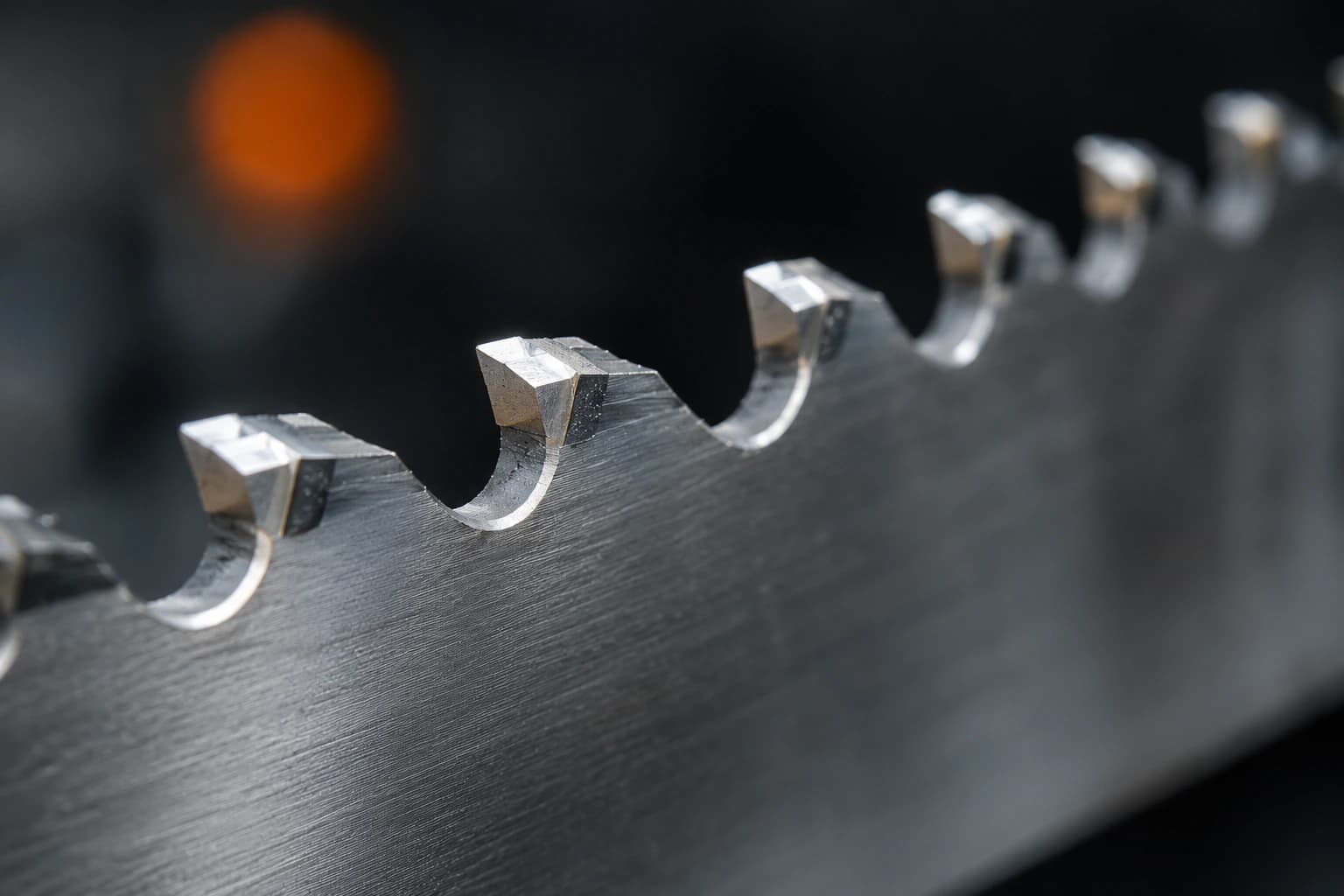
A bi-metal blade solves a contradiction. Teeth hard enough to cut steel are too brittle to survive flexing around a bandsaw's wheels, and a band springy enough to flex all day is too soft to hold an edge in metal. The construction answers both at once: a narrow strip of high speed steel, commonly M42 or M51, is welded along a fatigue-resistant alloy steel backing, and the teeth are then milled so only the tips are high speed steel. The edge keeps its hardness at the temperatures steel cutting generates, while the backing absorbs the constant bending that would crack a through-hardened band.
That split is why bi-metal is the default in fabrication and engineering workshops. One construction covers aluminium, brass and copper, mild and structural steel, stainless and tool steels and cast iron. Wood and softer materials are the ground of carbon steel blades. The choices that remain are the edge grade and the tooth pitch, and both are dealt with below.
M42 or M51: choosing the edge
Bi-metal blades pair a high speed steel edge with the same style of alloy backing. M42 covers most workshops; M51 and similar premium grades exist for the work that wears M42 out. Each product page states the edge as its manufacturer publishes it. When even a premium edge struggles, the next construction up is a carbide-tipped blade.
| Consideration | M42 | M51 and similar premium grades |
|---|---|---|
| Edge material | Cobalt high speed steel. | High speed steel carrying more tungsten. |
| Behaviour under heat | Keeps its hardness at the temperatures generated when cutting steel, so the edge cuts rather than rubs as the work heats up. | Holds hardness further into hot, abrasive cutting; the margin tells most on long cuts through large solid sections. |
| Wear behaviour | Outlasts carbon steel teeth on ferrous work. | Wears slower again on tough, abrasive ferrous material where M42 edges dull early. |
| Typical work | The everyday fabrication mix: steel, alloy steel, stainless steel, iron and non-ferrous metals. | Tempered steels, larger solid sections and some exotic alloys. |
| When to choose it | Start here. It is the default edge for general fabrication and engineering. | Step up when M42 blades wear quickly on tough ferrous material rather than failing from fatigue. |
| In this range | Blades their makers name M42, for example Production M42 Bandsaw Blade, Rx+ M42 vp Bandsaw Blade and Rx+ EHS M42 Extra Heavy Set Bandsaw Blade. | Premium lines, published for special and difficult alloys and tool steel, for example 3854 Sandflex King Cobra PQ Bandsaw Blade and 3858 King Cobra P9000 PQ Bandsaw Blade. |
What bi-metal blades cut
The materials below come from the manufacturers' published ranges for this construction. The guidance is general: section size, machine condition and feed discipline matter as much as the material name. Steel cuts best with coolant, and our cutting fluids guide explains what it does.
| Material | Cutting guidance |
|---|---|
| Structural steel | Box, angle and beam are interrupted cuts through thin walls. Choose a finer variable pitch so several teeth share each wall, and keep the feed steady where the blade breaks through a face. |
| Mild steel | Solid bar wants a coarser pitch with gullet room for a full chip. Feed positively so every tooth bites; a blade allowed to rub polishes the cut face and dulls itself. |
| Stainless steel | Work hardens the instant a tooth rubs instead of cuts. Bite from the first pass, never dwell in the cut and keep the coolant generous. |
| Tool steel | Annealed grades saw respectably on premium bi-metal with a firm feed and an unhurried band speed. Hardened material is carbide territory rather than a job for HSS teeth. |
| Aluminium | Fast cutting but gummy. A coarse pitch keeps the gullets clear of packed swarf, and a sharp blade with a steady feed stops the soft alloy smearing onto the tooth face. |
| Brass | Usually free cutting with short chips. A medium pitch and moderate feed give clean faces; ease the feed on thin sheet so the teeth do not snatch. |
| Copper | Soft and gummy rather than hard. Keep the pitch on the coarse side for the section and change the blade while it is still sharp: a dull edge tears rather than cuts. |
| Cast iron | The skin is harder and more abrasive than the core, so feed firmly through it rather than easing in. Expect powdery swarf and follow the machine guidance on cutting dry or with coolant. |
Picking tooth pitch and width
Width first: fit the widest band your machine will tension properly for straight, deep cuts, and only go narrower when the work curves. Pitch then follows the section you cut, not the material's name.
Measure the section
Measure the metal the teeth actually pass through: wall thickness on tube and box, full width on solid bar. The thinnest part of the cut governs the pitch.
Apply the teeth-in-cut rule
Aim for between 4 and 24 teeth in the cut at any moment. Fewer and each tooth takes too big a bite and can strip; more and the gullets fill before they clear, so the blade rubs.
Coarse for solids, fine for walls
Big solids run coarse, with variable pitches in the 2/3 to 4/6 TPI range, so the gullets can carry a full chip. Thin wall tube and profiles run finer, such as 8/12 or 10/14, to avoid tooth strippage.
Mixed work runs variable
A variable pitch band covers a spread of section sizes and breaks up the vibration a fixed pitch can set off, so one blade handles a varied cutting list without constant changes.
Each product page lists that blade's published width and TPI options. If you would rather answer questions than read a chart, the blade wizard applies the same rules for you.
The bi-metal range
16 blades from Bahco, Morse and Lenox with published widths from 13 to 67mm, every one welded to the length you order.
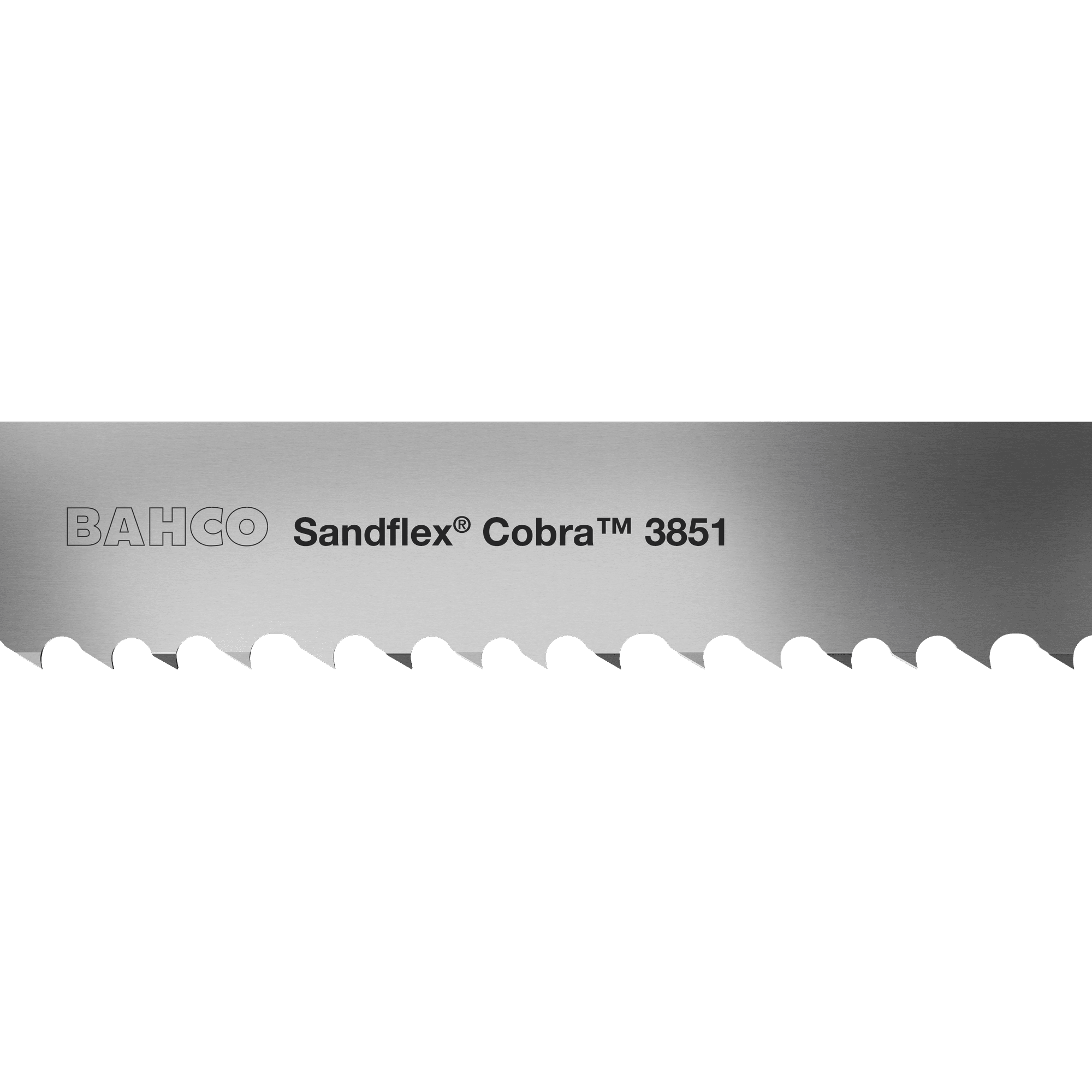
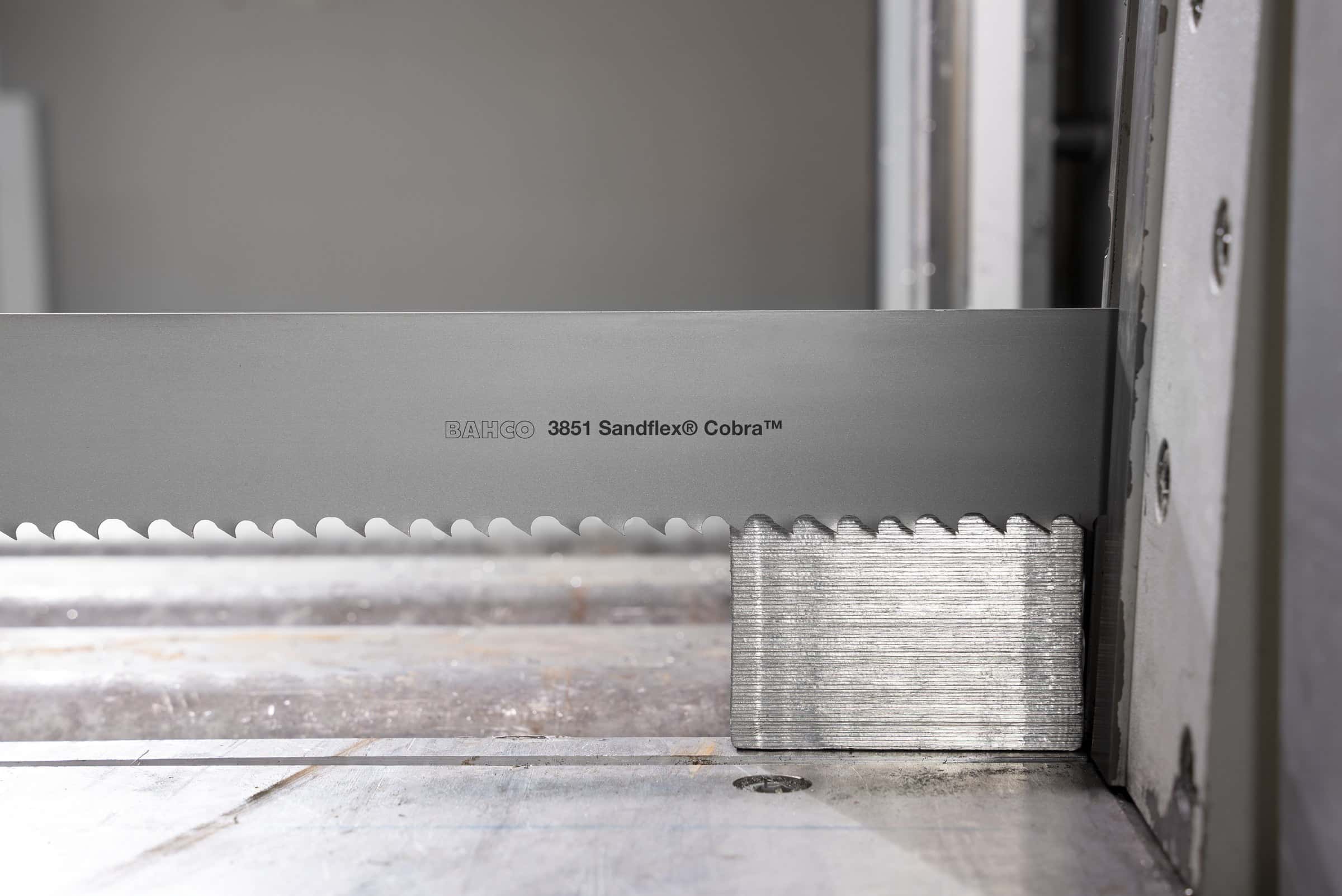
Bahco 3851
3851 Sandflex Cobra PRX Bandsaw Blade
- Widths
- 27 to 67mm
- Thickness
- 0.9 to 1.6mm
- TPI
- 0.7/1 to 10/14
- Tooth form
- PRX
ConfigureFrom £13.12 ex VAT
From £15.74 inc VAT
Bahco 3854
3854 Sandflex King Cobra PQ Bandsaw Blade
- Widths
- 27 to 67mm
- Thickness
- 0.9 to 1.6mm
- TPI
- 0.9/1.2 to 4/6
- Tooth form
- PQ
ConfigureFrom £14.53 ex VAT
From £17.44 inc VAT
Bahco 3858
3858 King Cobra P9000 PQ Bandsaw Blade
- Widths
- 41 to 54mm
- Thickness
- 1.3 to 1.6mm
- TPI
- 0.9/1.2 to 3/4
- Tooth form
- PQ
ConfigureFrom £20.80 ex VAT
From £24.96 inc VAT
Bahco 3858
3858 King Cobra PHX Bandsaw Blade
- Widths
- 34 to 67mm
- Thickness
- 1.1 to 1.6mm
- TPI
- 0.7/1 to 3/4
- Tooth form
- PHX
ConfigureFrom £17.71 ex VAT
From £21.25 inc VAT
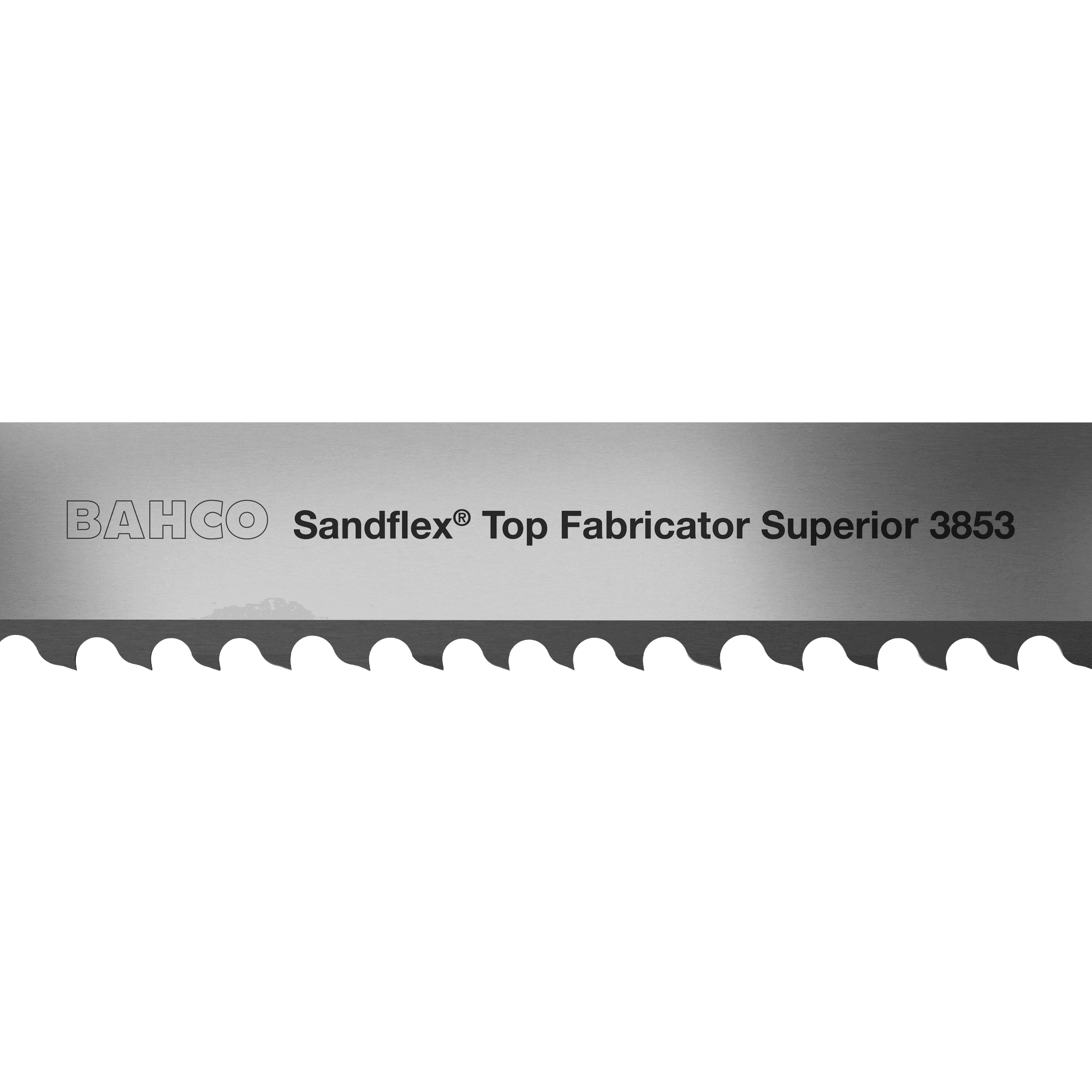
Bahco 3853
3853 Sandflex Top Fabricator PF Bandsaw Blade
- Widths
- 34 to 67mm
- Thickness
- 1.1 to 1.6mm
- TPI
- 2/3 to 8/11
- Tooth form
- PF
ConfigureFrom £15.77 ex VAT
From £18.92 inc VAT
Bahco 3853
3853 Sandflex Top Fabricator PF-W Bandsaw Blade
- Widths
- 41 to 67mm
- Thickness
- 1.3 to 1.6mm
- TPI
- 2/3-W to 3/4-W
- Tooth form
- PF-W
ConfigureFrom £17.96 ex VAT
From £21.55 inc VAT
Bahco 3857
3857 Easy-Cut EZ Bandsaw Blade
- Widths
- 13 to 34mm
- Thickness
- 0.6 to 1.1mm
- TPI
- S, M and L
- Tooth form
- EZ
ConfigureFrom £11.79 ex VAT
From £14.15 inc VAT
Morse
Challenger Bandsaw Blade
- Widths
- 27 to 54mm
- Thickness
- 0.9 to 1.6mm
- TPI
- 2/3 to 5/7
ConfigureFrom £13.21 ex VAT
From £15.85 inc VAT
Morse
Maverick Bandsaw Blade
- Widths
- 27 to 54mm
- Thickness
- 0.9 to 1.6mm
- TPI
- 1.4/2.5 to 5/7
ConfigureFrom £13.17 ex VAT
From £15.80 inc VAT
Morse
Production M42 Bandsaw Blade
- Widths
- 13 to 27mm
- Thickness
- 0.6 to 0.9mm
- TPI
- 3 to 10/14
- Tooth forms
- Hook and Regular
ConfigureFrom £8.43 ex VAT
From £10.12 inc VAT
Morse
Independence Bandsaw Blade
- Widths
- 34 to 41mm
- Thickness
- 1.1 to 1.3mm
- TPI
- 3/4
ConfigureFrom £16.23 ex VAT
From £19.48 inc VAT
Lenox
Rx+ M42 vp Bandsaw Blade
- Widths
- 34 to 41mm
- Thickness
- 1.1 to 1.3mm
- TPI
- 2/3
- Tooth form
- vp
ConfigureFrom £31.68 ex VAT
From £38.02 inc VAT
Lenox
Rx+ EHS M42 Extra Heavy Set Bandsaw Blade
- Width
- 54mm
- Thickness
- 1.6mm
- TPI
- 2/3 to 3/4
- Tooth form
- Extra Heavy Set
ConfigureFrom £52.58 ex VAT
From £63.10 inc VAT
Lenox
Classic Pro M42 vp Bandsaw Blade
- Width
- 41mm
- Thickness
- 1.3mm
- TPI
- 3/4
- Tooth form
- vp
ConfigureFrom £33.78 ex VAT
From £40.54 inc VAT
Lenox
HRX EHS M42 Extra Heavy Set Bandsaw Blade
- Width
- 54mm
- Thickness
- 1.6mm
- TPI
- 3/4
- Tooth form
- Extra Heavy Set
ConfigureFrom £52.58 ex VAT
From £63.10 inc VAT
Lenox
Contestor GT M42 vp Bandsaw Blade
- Width
- 41mm
- Thickness
- 1.3mm
- TPI
- 2/3
- Tooth form
- vp
ConfigureFrom £45.08 ex VAT
From £54.10 inc VAT
Industries that run on bi-metal
Where this construction is the first blade on the saw, and where it works alongside carbide for the hardest jobs.
Bi-metal as standard
Structural Steel, Fabrication and General Engineering
Steel fabricators, structural steelwork contractors and general engineering job shops cutting solids, tubes, profiles and castings.
Bi-metal as standard
Stainless Steel Processing
Food-grade, chemical and marine fabricators processing stainless sections, tube and plate offcuts.
Bi-metal in the mix
Tool, Die and High-Temperature Alloys
Toolrooms, die shops and aerospace and energy subcontractors cutting tool steel, nickel and high-temperature alloys.
Bi-metal in the mix
Non-Ferrous Metals and Foundry
Foundries and non-ferrous fabricators cutting aluminium, brass, copper, bronze and magnesium, including gates and risers.
Bi-metal in the mix
Timber and Sawmilling
Sawmills and forestry processors breaking down logs and resawing hardwood and softwood.
Bi-metal in the mix
Joinery, Furniture and Wood Panel
Joineries, furniture makers and panel processors cutting MDF, chipboard, mouldings and solid timber.
Material guides for this range


From the blog
 Carbide-tipped blades
Bi-metal vs carbide bandsaw blades, an honest decision guide
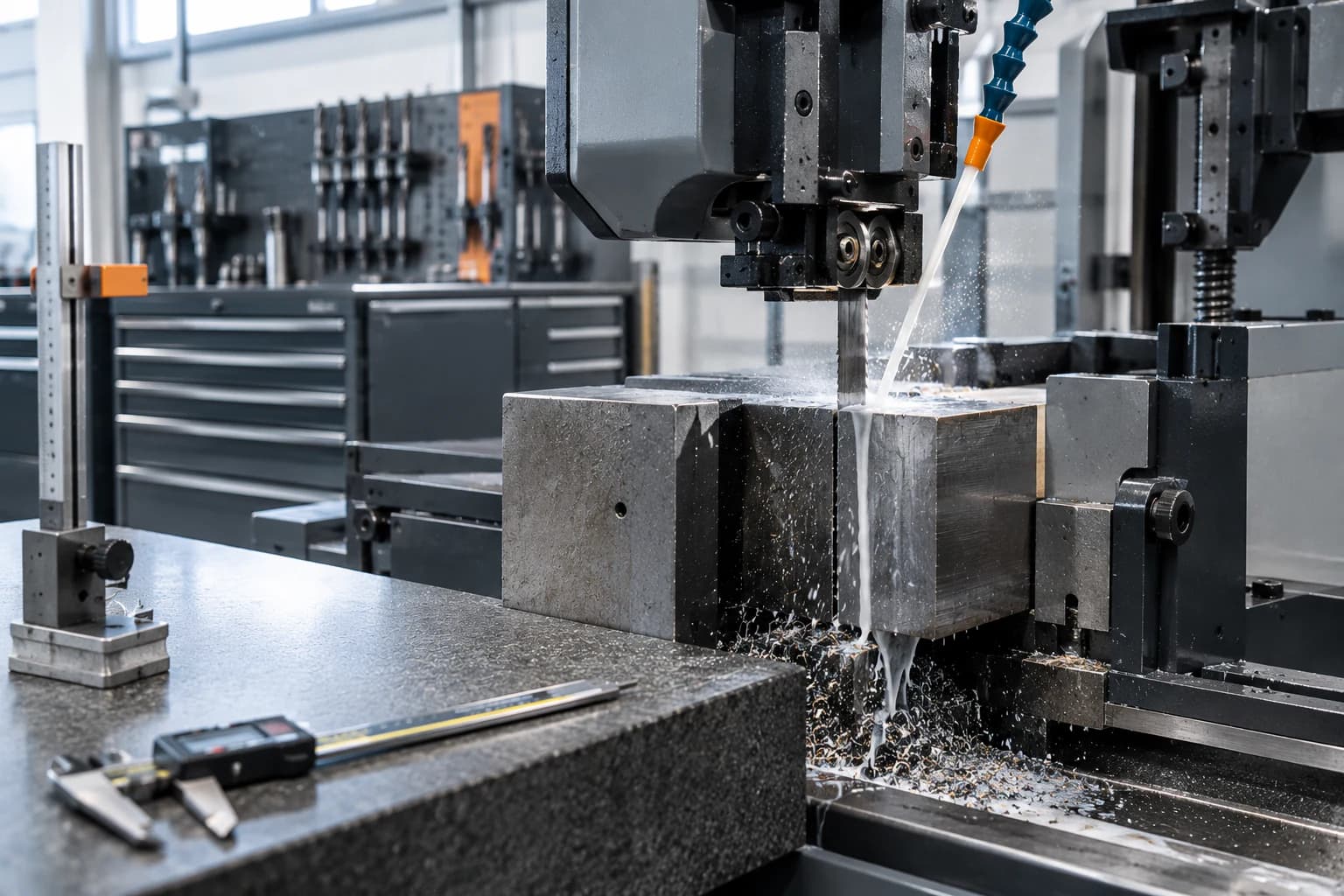
How bi-metal and carbide-tipped bandsaw blades are made, where each construction wins and how to judge them on cost per cut rather than price per blade.
 Bi-metal blades
Breaking in a new bandsaw blade, why and how
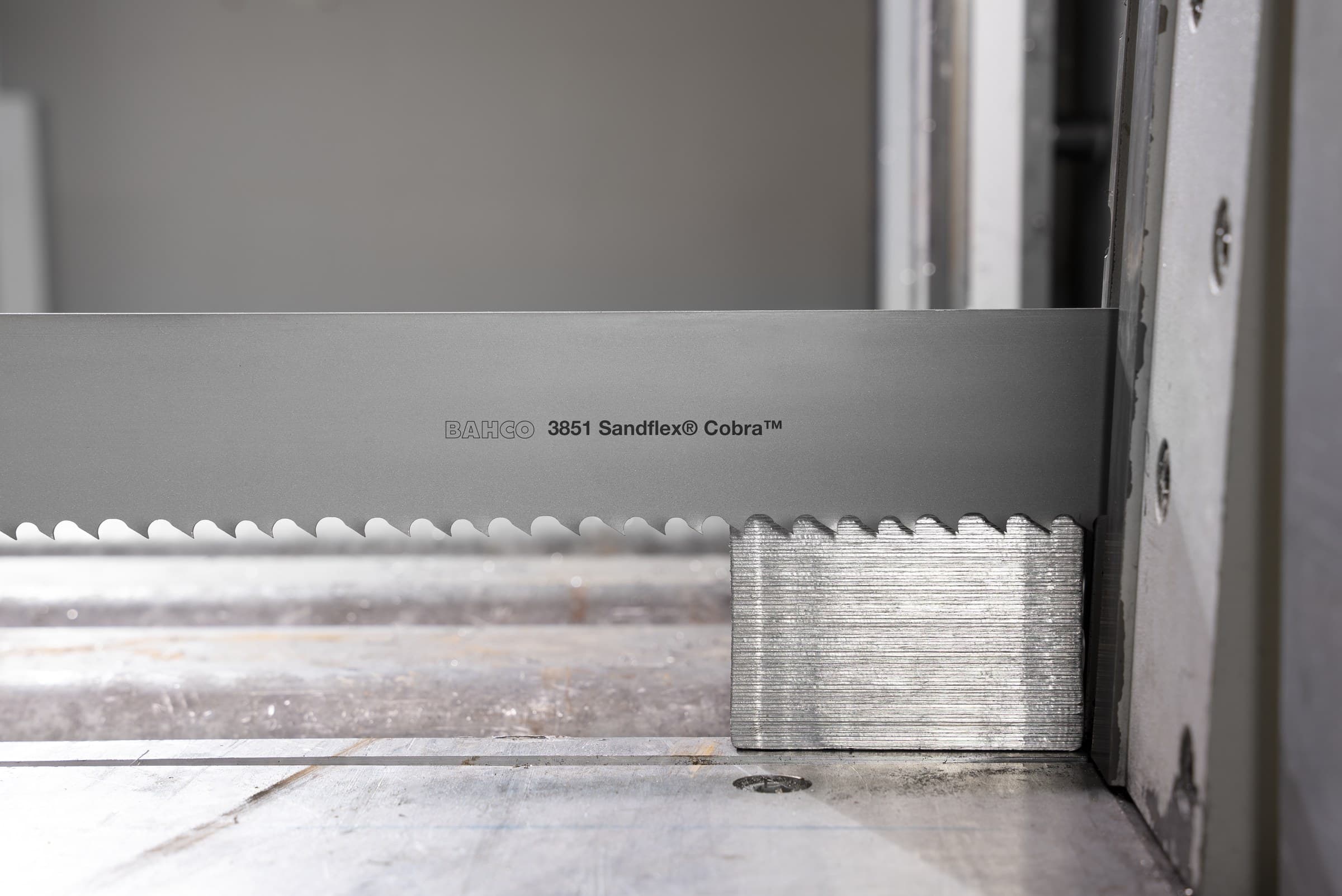
A razor-fresh bandsaw blade micro-chips under full feed. A short break-in at reduced feed hones the edge instead and repays itself in blade life.
 Bi-metal blades
M42 vs M51 bandsaw blades, when the upgrade pays
M42 and M51 are the two cobalt HSS grades on bi-metal bandsaw blades. What separates them, when M42 is enough and when M51 repays its higher price.
Frequently asked questions
What does M42 mean on a bandsaw blade?
When should I step up from M42 to M51?
What TPI should I choose for solid steel bar?
Do bi-metal blades cut wood as well as metal?
Tell us the length your machine takes and we will weld your bi-metal blade to match.
Order a custom length