
Bahco and Morse
Carbide-tipped bandsaw blades
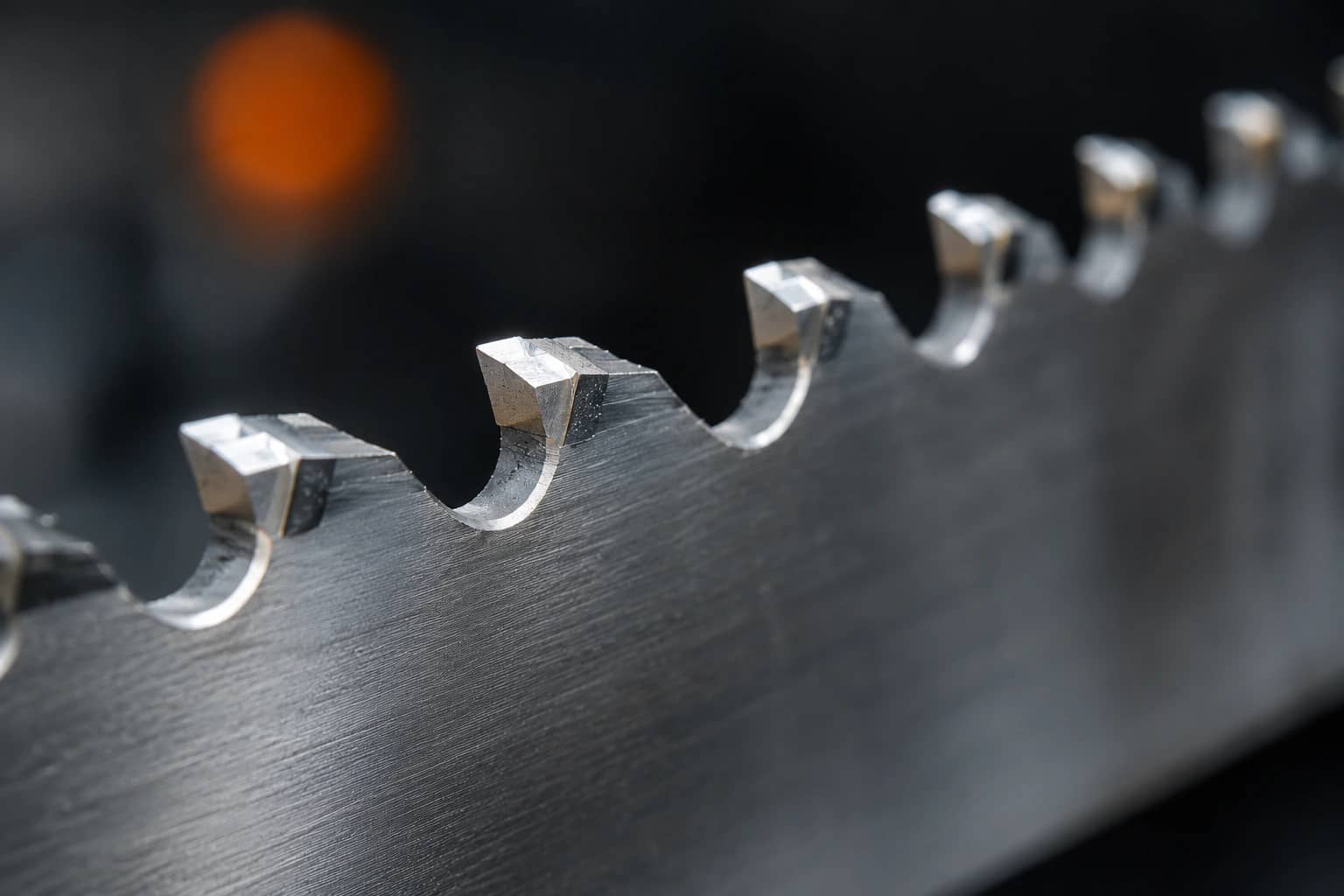
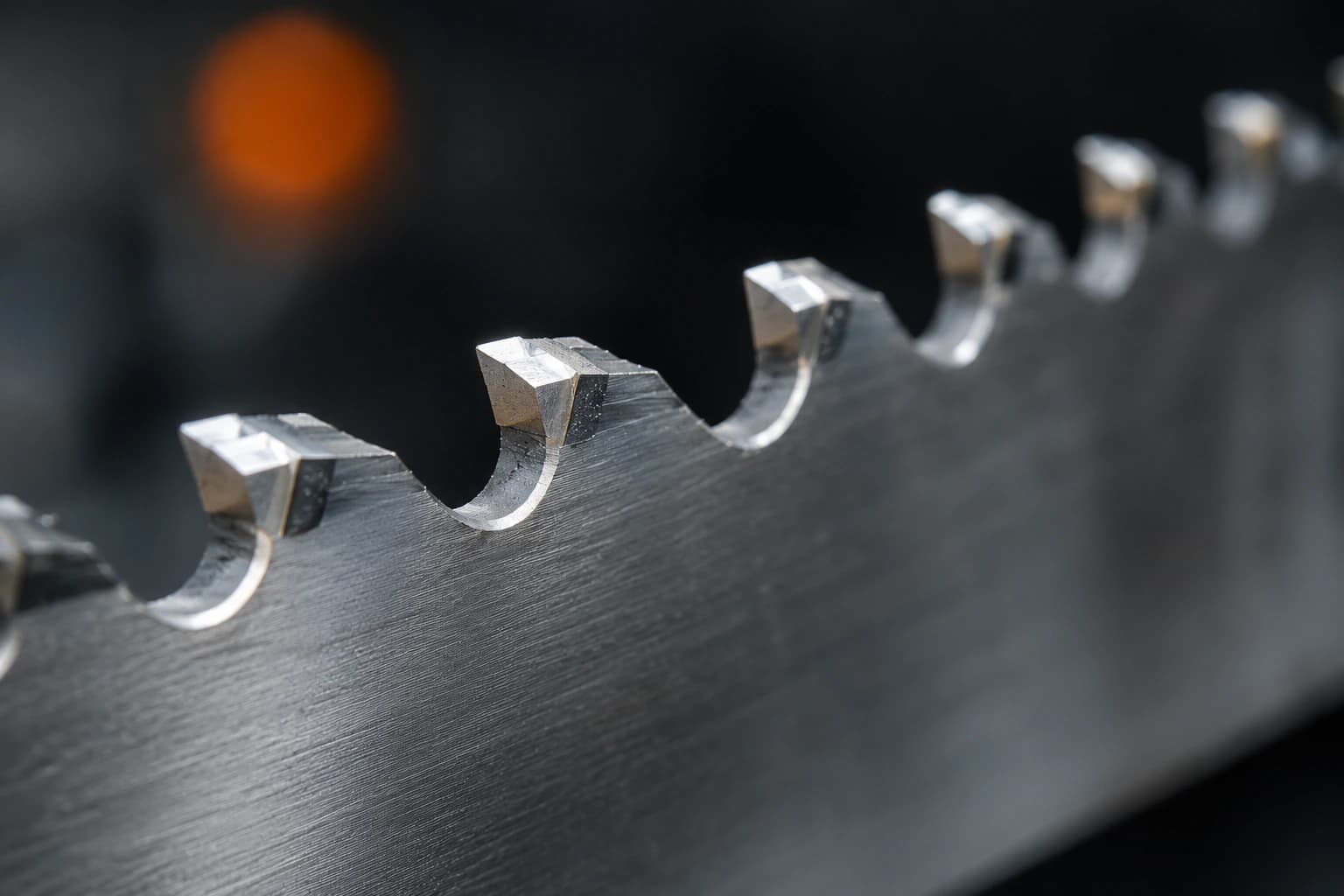
Tungsten carbide tips keep their hardness at temperatures that finish an HSS edge, which is what puts titanium, nickel alloys and hardened tool steels within a bandsaw's reach. Every band is welded to your machine's exact length.
Why carbide, in one property
Every tooth edge fails the same way: the tip runs hotter than its hardness can survive. Carbon steel gives up first, high speed steel holds on longer and tungsten carbide keeps its hardness far beyond the temperatures that stop an HSS edge. That one property is the whole case for the category. A carbide-tipped band keeps a true cutting edge in the alloys that defeat bi-metal blades: titanium, nickel-based high-temperature alloys, hardened and abrasive tool steels and demanding foundry work.
The construction pairs tungsten carbide tips with an alloy backing, and some blades carry a further coating for the hardest work. The backing flexes around the wheels; only the tips meet the material. None of it is cheap per blade, and it is not meant to be. On the right workpiece, carbide's cutting rate and edge life usually make it the cheaper option per cut, which is the only figure a production saw should care about. On the wrong workpiece a good bi-metal band does the job for less, and our bi-metal guide covers that territory.
Set or unset: how the tips are arranged
The first question a carbide tooth line answers is whether its tips are set. It is the main fork in the range, and it follows the work rather than the budget.
A set blade angles some of its tips outward from the band, the same way set works on a conventional tooth line. Those offset tips cut a kerf with clearance around the band, and that clearance is what carries the blade through interrupted cuts and mixed work: changing sections, varied materials and castings with gates and risers still attached.
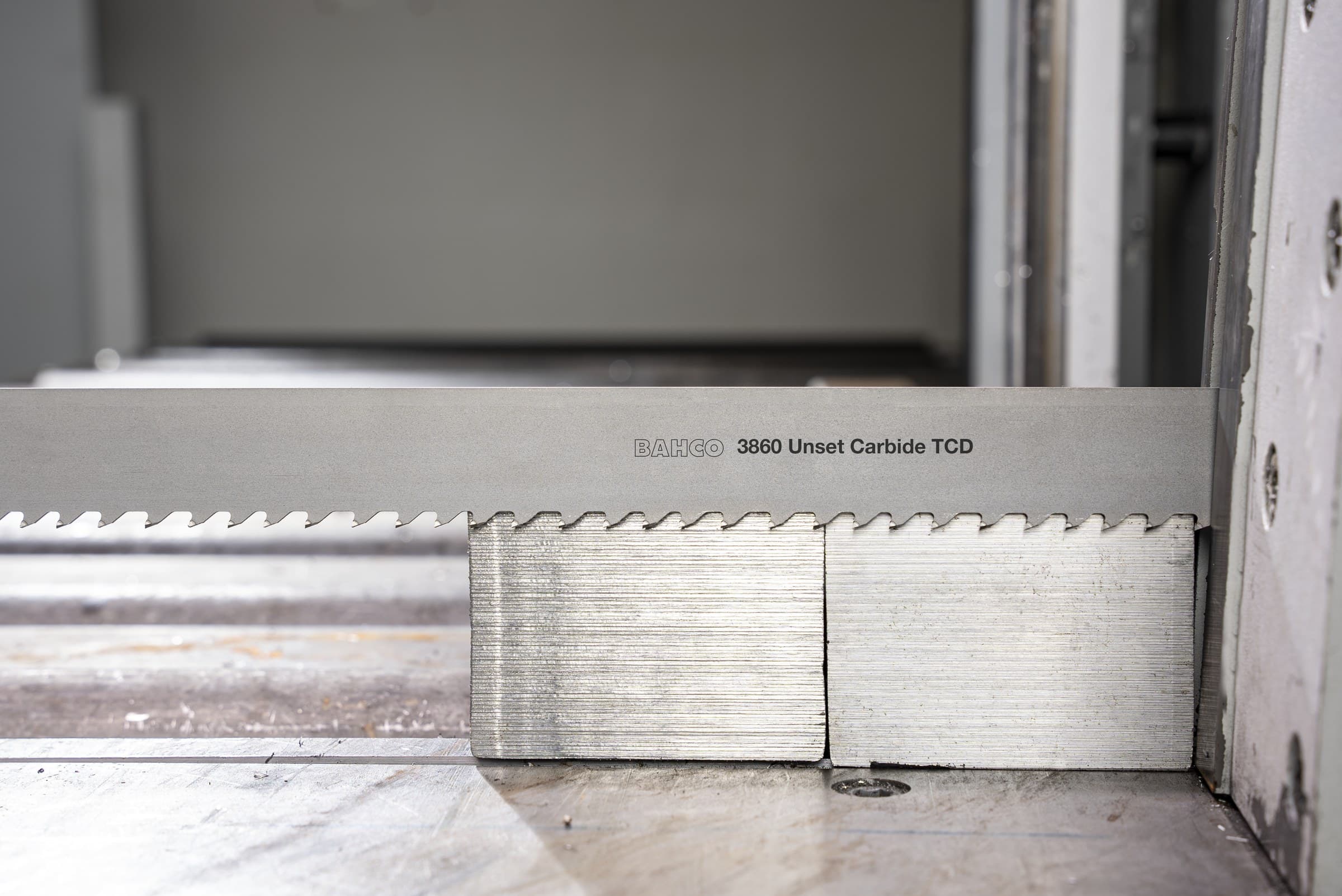
An unset blade keeps every tip in line. Instead of offsetting tips to make clearance, a multi-chip design gives consecutive tips different profiles, so the cut is split across them in sequence and each tip removes its own share of the kerf. That sequence is what buys the better finish and longer life on production cutting of hard alloys, where the same difficult material crosses the saw for days at a time.
If the saw sees a different job every hour, set is the safer geometry. If it earns its keep on one hard alloy at volume, unset multi-chip repays the discipline.
| Consideration | Set carbide | Unset multi-chip carbide |
|---|---|---|
| How the tips sit | Some tips are angled outward from the band, the same way set works on a conventional tooth line. | Every tip stays in line with the band. Consecutive tips carry different profiles and share the cut in sequence. |
| Where the clearance comes from | The outward set of the tips cuts a kerf with clearance around the band body. | The sequence of tip profiles divides the kerf between tips instead of offsetting them. |
| The work it suits | Interrupted cuts and mixed work: changing sections, varied materials and foundry pieces with gates and risers. | Production cutting of hard alloys, where finish and blade life decide the cost per cut. |
| In this range | Set tooth lines, for example 3868 Carbide Triple Set TSX Bandsaw Blade, 3868 Carbide Triple Set TSS Bandsaw Blade and 3869 Carbide Triple Set TS Bandsaw Blade. | Unset tooth lines, for example 3860 TMC TMC Bandsaw Blade. |
One more blade sits alongside both families, a trimetal construction: 3859 EZX Extreme Easy-Cut EZX Bandsaw Blade. Rated by its maker for structural steel, mild steel, stainless steel, cast iron, high-temperature alloys and tool steel.
What carbide-tipped blades cut
The workpieces below come from the manufacturers' published ranges for this construction. The guidance is general: the alloy, its condition and the section size matter as much as the blade. Generous coolant matters too, and our cutting fluids guide explains what it does.
| Material | Cutting guidance |
|---|---|
| High-temperature alloys | Nickel-based grades hold their strength at exactly the temperatures a cut generates, and many work harden if a tip rubs instead of cutting. Keep the feed positive so every tip takes a real chip, run coolant generously and favour coarser pitches whose gullets carry heat away with the swarf. |
| Titanium | Low thermal conductivity concentrates heat at the tooth tip rather than in the chip, which is exactly where ordinary edges fail. Moderate band speed, positive feed and generous coolant keep the tips alive; unset multi-chip patterns are the production choice here. |
| Tool steel | Annealed grades saw respectably on premium bi-metal; hardened and high-carbide grades need carbide tips to cut rather than rub. Match the blade to the state of the steel, not just the grade, and break a new band in gently before applying full feed. |
| Cast iron | The hard skin and abrasive graphite structure blunt conventional teeth quickly; carbide tips cut through the skin cleanly. Interrupted casting faces favour a set tooth line for its clearance. |
| High-silicon aluminium | Silicon-rich casting alloys wear edges like sandpaper while the soft aluminium around them packs gullets. Run a coarse pitch so the gullets keep clearing, keep the feed positive and keep the band clean so swarf never rides back into the cut. |
| Large or difficult sections | A duty as much as a material: big solids and awkward workpieces that keep the band in the cut for a long time. Go coarser than instinct suggests so the teeth in the cut stay within the working rule, clamp rigidly and let a steady feed do the work. |
Width and pitch on a carbide band
Width buys beam strength. A wider band deflects less under feed pressure, so a deep cut runs straighter and the machine can carry more feed without the cut wandering. This range carries published widths from 13 to 67mm, so check what your machine will tension properly before choosing: carbide rewards a rigid machine, positive feed control and correct band tension, and our tension how-to takes the guesswork out of the last one.
Pitch follows the section, not the material. The working rule of thumb is to keep between 4 and 24 teeth in the cut at any moment: fewer and each tip takes too heavy a bite, more and the gullets fill before they clear the kerf while the feed spreads so thin that tips rub instead of cutting. The published pitches across this range are 0.7/1, 1/1.15, 1/1.25, 1.4/2, 1.5/2.0, 1.6, 2, 2/3, 3, 3/4, 4 and 4/6 TPI, and each product page lists which pitches its widths carry.
Two habits protect the investment: break a new band in gently before running at full feed, and follow the machine and blade guidance on band speed for the alloy being cut. If weighing all this feels like guesswork, the blade wizard asks about your material and machine and applies the same rules for you.
The carbide-tipped range
9 blades from Bahco and Morse, with published widths from 13 to 67mm, every band welded to the length you order.
Bahco 3859
3859 EZX Extreme Easy-Cut EZX Bandsaw Blade
- Widths
- 27 to 67mm
- Thickness
- 0.9 to 1.6mm
- TPI
- 1.4/2 to 4/6
- Tooth form
- EZX
ConfigureFrom £28.55 ex VAT
From £34.26 inc VAT
Bahco 3860
3860 TMC TMC Bandsaw Blade
- Widths
- 41 to 67mm
- Thickness
- 1.3 to 1.6mm
- TPI
- 0.7/1 to 2/3
- Tooth form
- TMC
ConfigureFrom £38.87 ex VAT
From £46.64 inc VAT
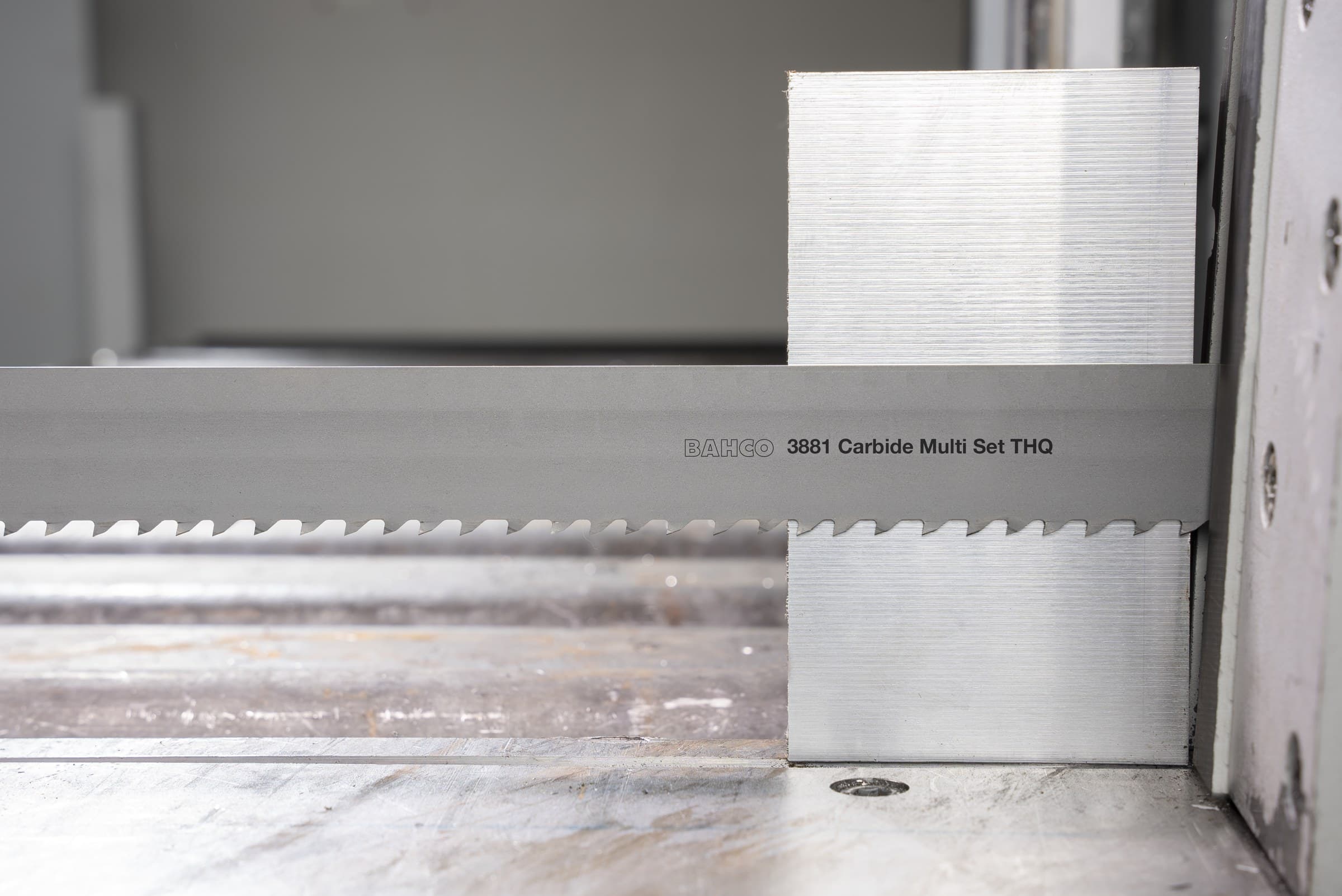
Bahco 3881
3881 Carbide Multi Set THQ Bandsaw Blade
- Widths
- 34 to 67mm
- Thickness
- 1.1 to 1.6mm
- TPI
- 1/1.15 to 2/3
- Tooth form
- THQ
ConfigureFrom £38.87 ex VAT
From £46.64 inc VAT
Bahco 3881
3881 Carbide Multi Set THS Bandsaw Blade
- Widths
- 41 to 67mm
- Thickness
- 1.3 to 1.6mm
- TPI
- 1/1.25 to 2/3
- Tooth form
- THS
ConfigureFrom £40.16 ex VAT
From £48.19 inc VAT
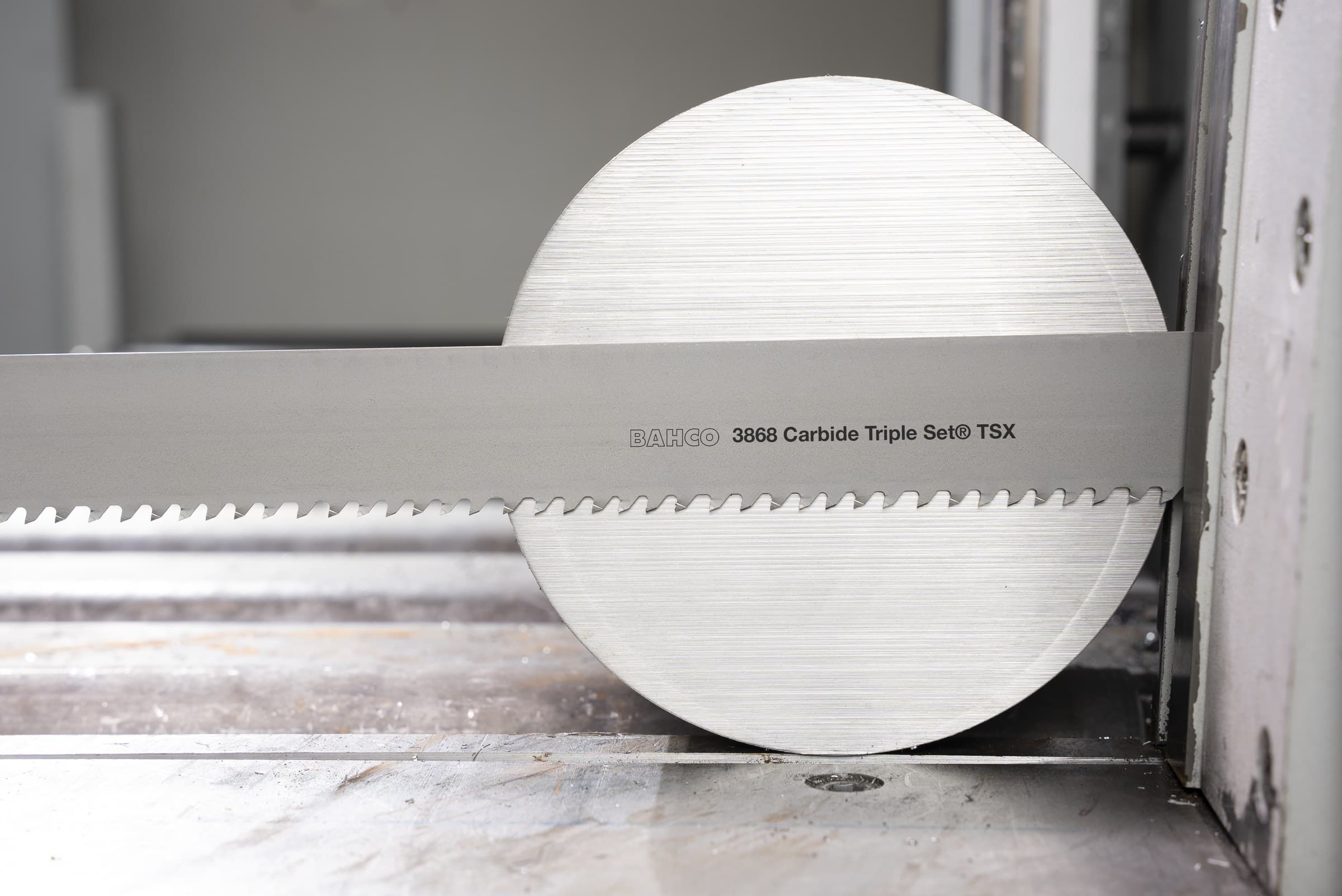
Bahco 3868
3868 Carbide Triple Set TSX Bandsaw Blade
- Widths
- 27 to 67mm
- Thickness
- 0.9 to 1.6mm
- TPI
- 0.7/1 to 3/4
- Tooth form
- TSX
ConfigureFrom £36.08 ex VAT
From £43.30 inc VAT
Bahco 3868
3868 Carbide Triple Set TSS Bandsaw Blade
- Widths
- 27 to 67mm
- Thickness
- 0.9 to 1.6mm
- TPI
- 0.7/1 to 3/4
- Tooth form
- TSS
ConfigureFrom £37.37 ex VAT
From £44.84 inc VAT
Bahco 3869
3869 Carbide Triple Set TS Bandsaw Blade
- Widths
- 13 to 34mm
- Thickness
- 0.9 to 1.1mm
- TPI
- 2 to 4
- Tooth form
- TS
ConfigureFrom £34.57 ex VAT
From £41.48 inc VAT
Morse
M-Factor GES Bandsaw Blade
- Width
- 34mm
- Thickness
- 1.1mm
- TPI
- 2/3
ConfigureFrom £41.02 ex VAT
From £49.22 inc VAT
Morse
M-Factor GP Bandsaw Blade
- Widths
- 34 to 41mm
- Thickness
- 1.1 to 1.3mm
- TPI
- 1.5/2.0 to 2/3
ConfigureFrom £35.61 ex VAT
From £42.73 inc VAT
Where carbide earns its keep
The industry guides that reach for carbide, some as the first choice and some when the hard end of the mix arrives.
Carbide as the first choice
Tool, Die and High-Temperature Alloys
Toolrooms, die shops and aerospace and energy subcontractors cutting tool steel, nickel and high-temperature alloys.
Carbide as the first choice
Non-Ferrous Metals and Foundry
Foundries and non-ferrous fabricators cutting aluminium, brass, copper, bronze and magnesium, including gates and risers.
Carbide for the hard end
Structural Steel, Fabrication and General Engineering
Steel fabricators, structural steelwork contractors and general engineering job shops cutting solids, tubes, profiles and castings.
Carbide for the hard end
Stainless Steel Processing
Food-grade, chemical and marine fabricators processing stainless sections, tube and plate offcuts.
Material guides for carbide work


Frequently asked questions
When is a carbide-tipped blade worth the extra cost?
What is the difference between set and unset carbide blades?
Do carbide blades need different machine settings?
Tell the blade wizard your material, section and machine and it will say plainly whether carbide or bi-metal suits the job.
Start the blade wizard