
Dakin-Flathers Saw37C
Carbon steel bandsaw blades
The workhorse family for wood, panel products, plastics and non-ferrous metals: hardened carbon teeth on an economical band, welded to the exact length your machine takes.
One steel, two backs
Every blade in this family is milled from one strip of hardened carbon steel: teeth and body are the same material, with no alloy tip and no welded-on edge. That simplicity keeps the cost of a band down, which matters in workshops that change blades often, swap between varied profiles or would rather fit a fresh edge than nurse a dull one.
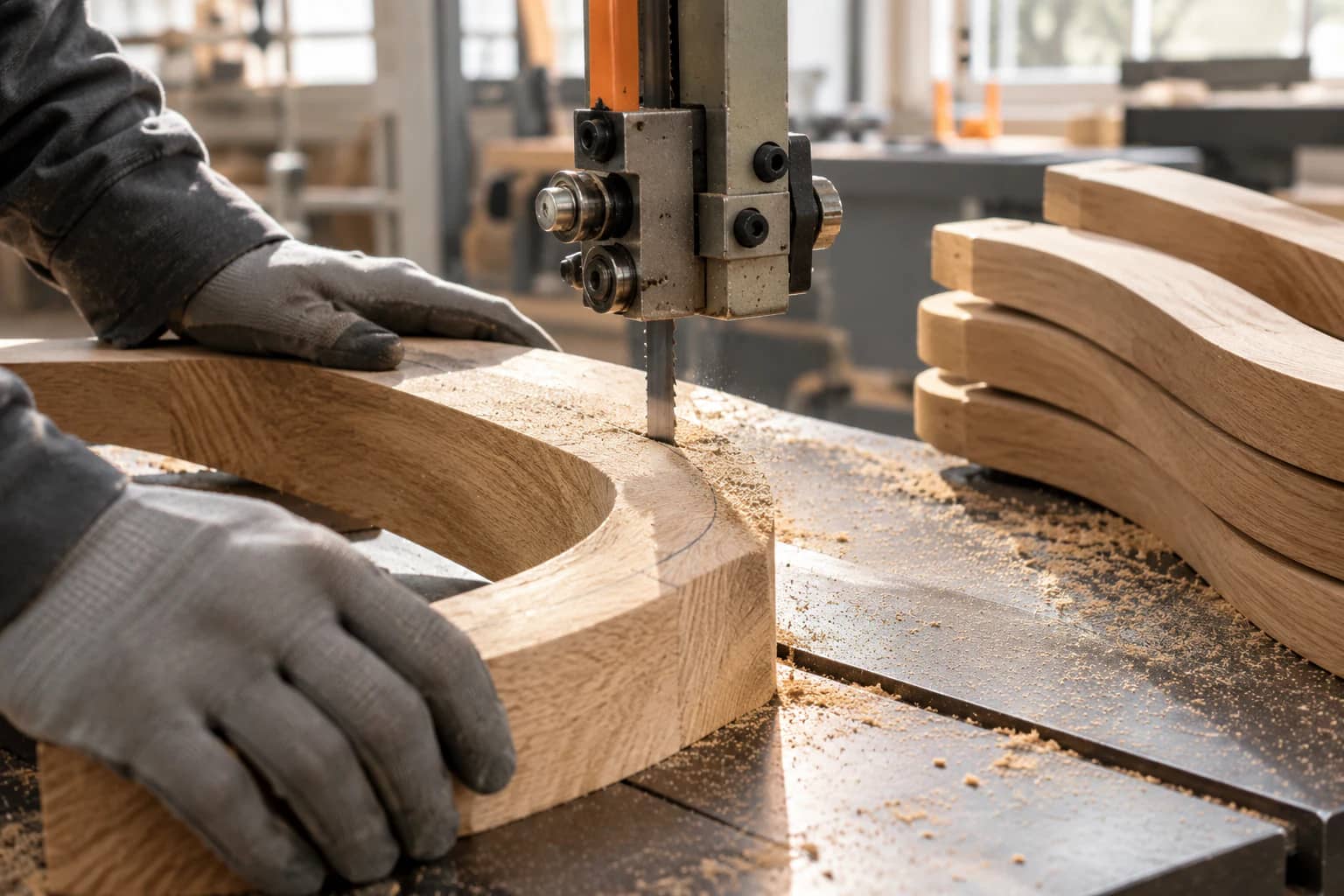
The choice inside the family is the back. A flexback blade hardens only the tooth edge and leaves the back softer, so the band flexes: it tolerates smaller wheel diameters and follows contour work willingly. A hardback blade is hardened through the back as well, trading flexibility for beam strength: under feed pressure in a deep, straight cut it holds its line. Between them the two backs cover softwood, hardwood, chipboard, MDF, plastics and non-ferrous metals. The last row of the table below shows which of the two we list at the moment.
Where the work turns to steel, step up to a bi-metal blade, whose high speed steel edge keeps its hardness at cutting temperature. Whatever the back, the band is welded to the exact loop length your machine takes.
Flexback or hardback
Same steel, same teeth, one difference: whether the back of the band is hardened. That single variable decides how the blade behaves, so it is the first question to settle before pitch or width.
| Consideration | Flexback | Hardback |
|---|---|---|
| Back hardness | Hardened tooth edge on a softer, flexible back. | Hardened through the back as well as the tooth edge. |
| Beam strength | Modest. The back gives under heavy feed pressure before the cut does, which is the price of its flexibility. | Higher. The stiff back resists deflection, so the band holds a straight line under feed pressure in deep cuts. |
| Wheel diameter tolerance | Tolerates smaller wheel diameters, which suits compact workshop bandsaws. | Prefers larger wheels: a fully hardened back is worked harder every time it bends over a small wheel. |
| Contour work | The contour blade. In narrower widths it follows curves willingly without binding in the kerf. | Built for straight-line cutting. When the cutting list curves, reach for a narrower flexback instead. |
| Typical duties | General woodworking, joinery, curved and varied profiles, plastics and non-ferrous metals. | Deep, straight ripping and resawing in timber and panel products, where accuracy under feed matters. |
| In our range | Saw37C Flex Back Carbon Bandsaw Blade | Not currently listed |
What carbon blades cut
The workpieces below are the manufacturer's published range for this family. The guidance is general workshop practice: your machine, feed and stock condition matter as much as the blade.
| Material | Cutting guidance |
|---|---|
| Softwood | Cuts fast and gently on the blade, but resin builds up on teeth and band until a coated edge rubs instead of cutting. Run coarser pitches on deep rips so the gullets clear the chip, keep the band clean and keep the feed steady. |
| Hardwood | Denser and more abrasive, so edges dull sooner and a wandering band burns the cut. Run the widest band your machine will tension for deep, straight ripping, and keep the feed positive so every tooth bites rather than rubs. |
| Chipboard | The resin glue line dulls a carbon edge faster than the wood fibre around it. A consistent, finer pitch keeps panel edges clean; treat blades as consumables and change them before the cut edge starts to chip out. |
| MDF | Uniform and predictable to cut, with fine dust as the price. A finer pitch leaves a crisp edge on faces and mouldings; watch your extraction and change the blade as soon as the cut face turns fluffy. |
| Plastics | Heat is the enemy: too fast a band or too timid a feed melts the kerf shut behind the blade. Keep band speed down, feed positively so the chip carries the heat away and prefer coarser pitches that will not clog. |
| Non-ferrous metals | Thin sections of aluminium, brass and copper cut well with a fine pitch and reduced band speed. Soft alloys pack gullets, so clear swarf often and keep the band lubricated. For steels, move to a bi-metal blade. |
Choosing pitch and width
This family carries published widths from 3 to 32mm and pitch options from 2 to 32 TPI; each product page lists its own options. Three general rules narrow them down quickly.
Keep 4 to 24 teeth in the cut
The working rule for any bandsaw blade: at least 4 teeth in the workpiece so the band does not snatch, no more than 24 so each tooth still bites and the gullets can clear. Measure the depth of cut, then pick the pitch that keeps you inside that window.
Fit the widest band the machine will tension
Width buys straightness. A wider band resists deflection in deep rips and resawing, so run the widest band your wheels and guides will tension properly and let the published width range set the ceiling.
Go narrower and finer for curves
Contour work reverses both rules. A narrower flexback band follows the radius without binding, and on shallow cuts a finer pitch puts more teeth in the work and leaves a cleaner face.
Rather answer questions than apply rules? The blade wizard works through the same logic for you.
The carbon steel range
From Dakin-Flathers: published widths from 3 to 32mm, every band welded to the length you order.
How carbon blades are priced
Our metal-cutting blades are priced by the millimetre. Carbon blades work differently: for each width there is a price for every length band, and a blade costs the price of the band its length falls in. That price covers the blade welded to the length you order.
Enter your length on the product page and the price for your length shows before you add the blade to your basket. Where a width is not offered at a length, that length is not available for that width.
- The first band covers lengths up to
- 2440mm (2.44m)
- The longest band ends at
- 10670mm (10.67m)
A blade longer than the longest band cannot be priced online. Contact us with the length you need.
Where carbon blades earn their keep
The industries that reach for carbon first, because blade cost per cut beats edge life per blade on their work.
Carbon blades as standard
Joinery, Furniture and Wood Panel
Joineries, furniture makers and panel processors cutting MDF, chipboard, mouldings and solid timber.
Carbon in the mix
Timber and Sawmilling
Sawmills and forestry processors breaking down logs and resawing hardwood and softwood.
Carbon in the mix
Pallet and Wood Recycling
Pallet dismantlers and wood-waste recyclers sawing nail-laden reclaimed timber.
Material guides for this family


Frequently asked questions
What are carbon steel bandsaw blades best for?
What is the difference between flexback and hardback carbon blades?
Can carbon steel blades cut metal?
Not sure a carbon blade is the right one for your work? Tell the blade wizard what you cut and it will shortlist a blade.
Try the blade wizard