
Industry guide
Clean edges for joinery and furniture production
What joineries and furniture makers need from a bandsaw blade for solid timber, MDF and chipboard: carbon steel as the workhorse, hardback carbon for straight, deep cuts and a bi-metal wood blade for abrasive hardwood, each welded to your machine's length.
Secondary woodworking lives or dies on edge quality and downtime. Whether you run a joinery shop cutting mouldings and solid timber or a panel line processing MDF and chipboard, you want a blade that cuts cleanly, changes quickly and does not punish you on cost when the glue line in a panel takes the edge off. Carbon steel blades, with a hardened carbon body and teeth and no alloy tip, are the sensible default here: pick the right pitch and they cover softwood, hardwood and panel products at a price that suits frequent changes.
For deep, straight cuts in thicker stock, a hardback carbon blade adds the beam strength that keeps components on line. And when abrasive or hard timber blunts carbon edges too quickly, a bi-metal wood blade keeps the machine cutting. Every blade is welded to your stated length.
Recommended blades for this work
Blades on sale today that suit this work, each with the reason from its own listing. Every one is welded to your machine's length.
Choosing between flexback and hardback carbon
Carbon steel blades are the workhorse of the joinery shop. A hardened carbon steel body and teeth, with no alloy tip, keeps the cost of each band down, which matters when panel products like MDF and chipboard dull edges faster than solid timber and blades change often. Flexback and hardback options let you balance flexibility against beam strength. The range covers softwood, hardwood, chipboard, MDF, plastics and non-ferrous metals, so one category serves most of the machines on the floor.
Hardback carbon blades earn their keep when furniture work becomes production work. The band is hardened through the back as well as the teeth, so it carries more beam strength and resists deflection under feed pressure. In high-output timber cutting that stability shows up as straighter cuts and more consistent components across a run. Step across from flexback when deep, straight cuts dominate the work; stay with flexback where curves and contour cutting need the band to tolerate smaller wheels.
On the saw table
The workpieces this industry actually feeds through a band, and what each asks of the blade.
Curved components in solid timber
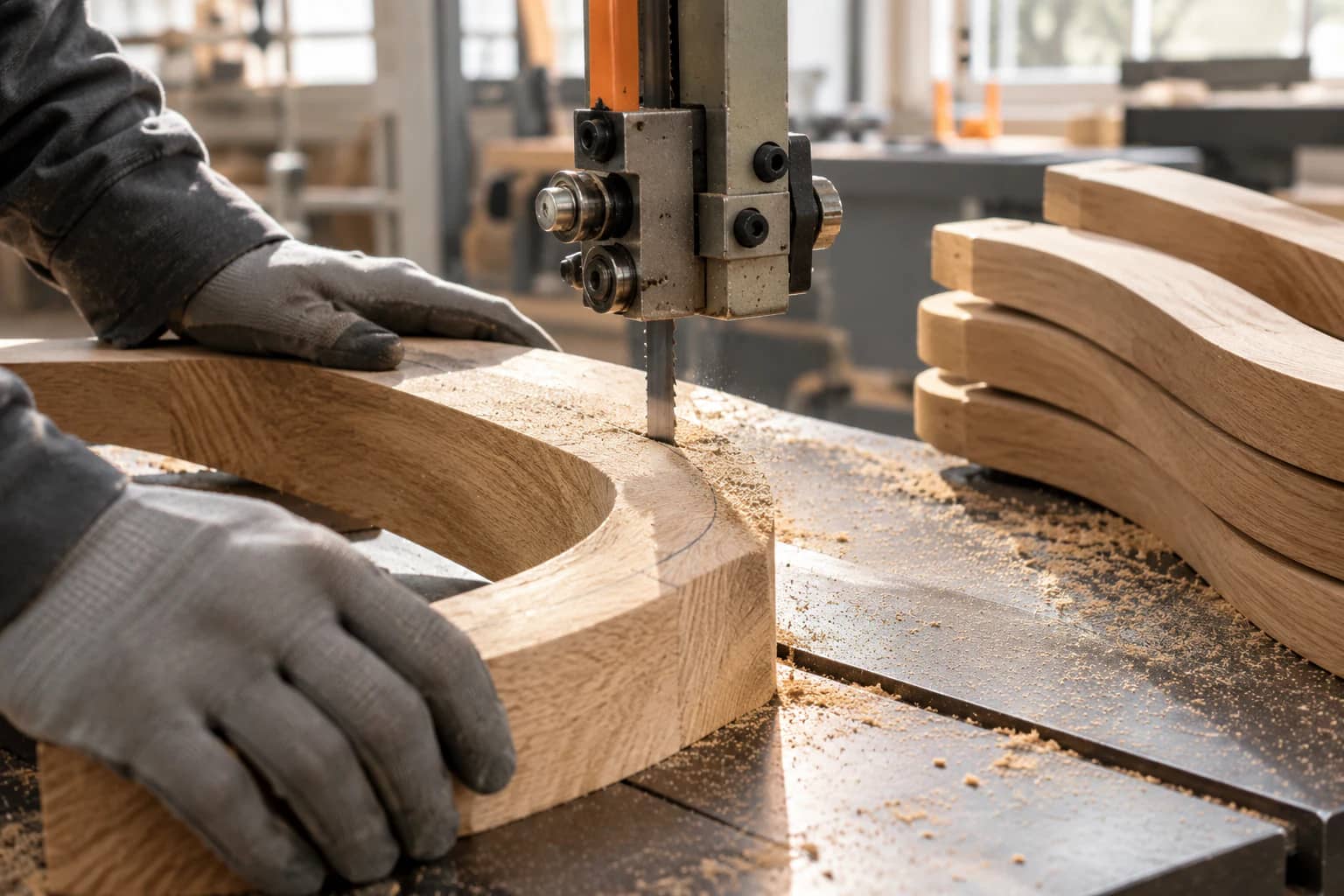
Chair backs, curved rails and shaped mouldings ask a narrow blade to follow a line without wandering. Narrow carbon blades are built for exactly this: curve and component cutting in wood, on widths at the narrow end of the range. Because the whole band is hardened carbon with no alloy tip, a workshop cutting curves all day can change blades often without the cost stinging.
Sizing MDF and chipboard panels
MDF and chipboard cut easily but wear edges hard: the resin that bonds the panel dulls a tooth faster than the wood fibre around it. That makes edge life, not cutting force, the real cost on a panel line. Carbon blades in a fine, consistent pitch give clean panel edges. Their low cost per band means you can swap a tired blade the moment finish starts to suffer rather than pushing it on.
Production runs in hardwood
Batching furniture components in dense hardwood puts a premium on consistency: every part off the saw should match the last and every saw mark is sanding time later. A hardback carbon blade resists deflection under feed pressure, which shows up as straighter cuts and more uniform components across the whole run. When the timber is hard or abrasive enough to blunt carbon edges too fast, a bi-metal wood blade steps in, with a fatigue-resistant backing built for long running life.
Material guides for this industry


Deeper guidance per workpiece, including the blades that genuinely cut it and why.
Frequently asked questions
Which bandsaw blade should a joinery shop keep as its everyday blade?
Why do MDF and chipboard dull blades faster than solid timber?
When is it worth moving from a carbon blade to a bi-metal wood blade?
Tell the blade wizard your material, machine and length and it will narrow the range for you.
Start the blade wizard