How to measure a bandsaw blade length
Three reliable ways to find your bandsaw blade length, from the machine plate to rolling an old blade along a tape or calculating from the wheel geometry.
The Bandsaw Store team
Bandsaw blade length is the full distance around the welded loop, measured in millimetres. There are three reliable ways to find it: read it from the machine's specification plate or manual, roll an old blade of the correct length along a tape, or calculate it from the wheel diameters and the distance between the wheel centres. The plate is the quickest and most accurate; the calculation is the fallback when nothing else survives.
Why there is no standard length
Every bandsaw model takes its own loop length, fixed by its wheel diameters and the distance between the wheel centres. Two machines from the same maker can be hundreds of millimetres apart, and there is no sizing convention to fall back on. That is why blades are sold by length and welded to order rather than picked from a shelf of fixed sizes: the loop has to match your machine, not a standard.
The good news is that the number is easy to find. Work through the three methods below in order and stop at the first one that gives you a figure you trust.
Method one: read the machine plate
Nearly every bandsaw states its blade length on the specification plate riveted to the frame, or in the manual, usually in millimetres. This is the figure the maker built the machine around, so it is the first place to look and the most reliable answer you will get.
Two things to check before taking it at face value. First, the units: an older British or American machine may quote the length in inches, and a figure like 93 1/2 inches needs converting before you order (multiply inches by 25.4 to get millimetres). Second, that the plate belongs to the machine: on second-hand saws it occasionally does not, so if the stated length looks wildly different from the blade currently fitted, measure and compare.
Method two: roll an old blade along a tape
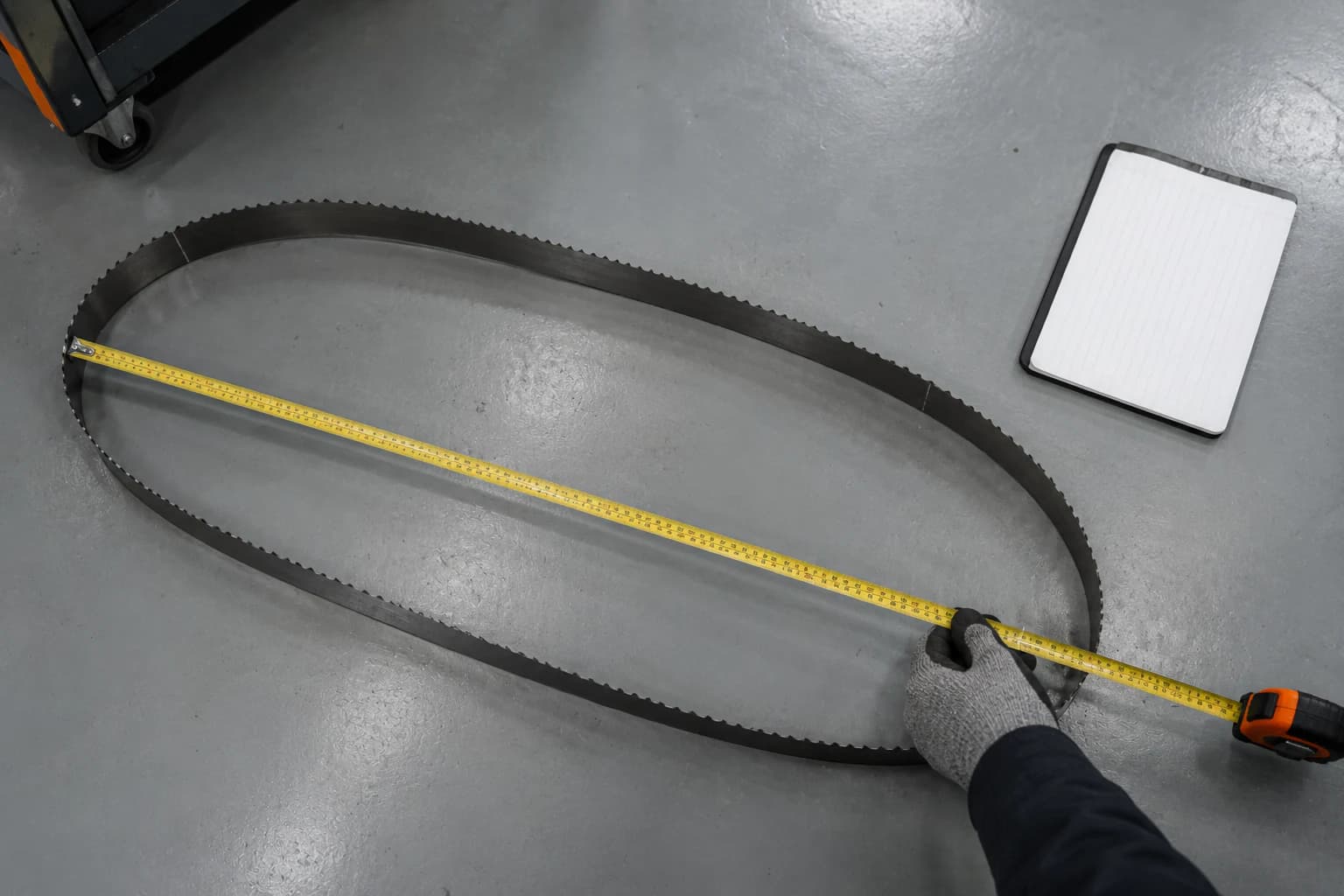
If the plate is missing or unreadable but you have a blade that fits the machine, measure that. Put a spot of paint or a marker line on the back of the band, set the mark against the start of a tape laid along the bench or floor, then roll the blade in a straight line, without letting it slip, until the mark comes round and touches down again. The distance travelled is the loop length.
With a little care this method is accurate to within a few millimetres. If the blade is broken, the job is easier still: pull it out straight and measure end to end. What you should not do is estimate from a blade coiled into its folded loops; the folds do not divide the length neatly and the answer will be out.
One caveat: a band that has done long, hard service can stretch slightly, so a well-used blade reads a shade long. It is a small effect, but if the old blade disagrees with a legible plate, trust the plate.
Method three: calculate from the wheel geometry
No plate, no manual and no old blade? The length can be calculated from the machine itself. For the common case of a two-wheel saw with equal wheels the geometry is simple: the blade wraps half of each wheel and runs straight between them.
In words: loop length equals twice the centre distance plus pi times the wheel diameter.
Two assumptions matter. Both wheels must be the same diameter, and the centre distance must be measured with the tensioner in the middle of its travel, so the finished blade lands where the machine has adjustment in both directions. Measure between the wheel centres, not the rims, and measure the wheel diameter across the surface the blade actually runs on, including any rubber tyre.
| Step | Worked example |
|---|---|
| Wheel diameter, both wheels | 350mm |
| Centre distance, tensioner at mid travel | 400mm |
| Formula in numbers | 2 x 400 + 3.1416 x 350 |
| Loop length | 800 + 1099.6 = 1899.6mm, order as 1900mm |
The table above is a worked example, not a machine specification: substitute your own measurements. If your saw has three wheels, or two wheels of different diameters, the formula gains terms and mistakes get easier to make. In that case send us the wheel diameters and centre distances through the contact page and we will work the length out for you.
Which method should you trust?
| Method | Typical accuracy | When to use it |
|---|---|---|
| Machine plate or manual | The maker's own figure | First choice whenever the plate is legible and original |
| Rolling an old blade | Within a few millimetres with care | Plate missing but a correct-length blade survives |
| Wheel geometry calculation | Good starting point, depends on tensioner position | Nothing else available, or as a cross-check |
What to do with the number
Order in millimetres, and measure twice before you do. Bandsaw tensioners have travel precisely so they can take up small differences, so a figure within a few millimetres of true will tension without drama. A figure tens of millimetres out may not fit the machine at all, and because a custom-length blade is made to order for your machine it is excluded from change-of-mind returns.
If you are stuck between two numbers, ask before ordering rather than splitting the difference. Once the length is settled, the rest of the specification (width, gauge, tooth pitch) is a separate decision, and the blade finder narrows the catalogue by machine and material.
Common mistakes to avoid
- Measuring the centre distance with the tensioner wound fully up or fully down. Set it mid travel first, or the calculated blade will sit at the end of the adjustment range.
- Mixing units. A length written down in inches and ordered in millimetres, or the reverse, is the most common measuring error we see.
- Measuring an old blade from a different machine. Blades migrate between saws in busy workshops, so confirm the band you are measuring actually ran on the machine you are buying for.
- Estimating from a coiled blade. Three folded loops do not equal one third of the length each with any useful precision.
- Ignoring wheel tyres. On wheels with rubber tyres the blade runs on the tyre surface, so include the tyre in the diameter.
Finally, remember that a correct length is only useful if the band is then tensioned properly: a perfectly measured loop still cuts badly on a slack machine. Our bandsaw blade tension guide covers how to set tension and how to know it is right.
The Bandsaw Store team
Technical points follow general engineering practice and the manufacturers' published ranges. If a question is not answered here, ask us directly.